Pages

Wednesday, 20 September 2006

Search results: navigation keyboard shortcuts


Following my post on the beauty of keyboard shortcuts, Luis Velez asked whether there was a hotkey for moving to the Next page of Google search results.

Yes, there can be. If you use the fab free browser Firefox (please download it via the sidebar link if you want to support this blog!), you can download a free extension for Fox which lets you use the keyboard to navigate search results pages on popular Net search engines like Google, Yahoo, even social bookmarking site Delicious.

That extension' s called Search Keys (here's how to install a Firefox extension). After installing it, a Google search results page will look like this:
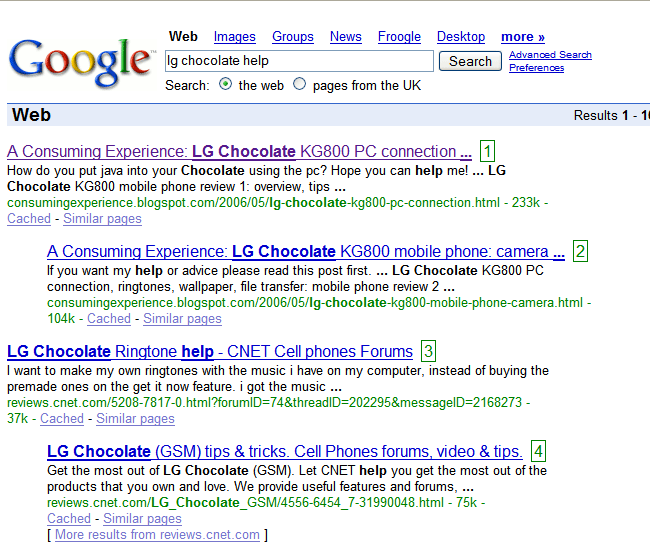

See the extra number in a green box after the heading of each search result in the list? Type a number on your keyboard e.g. 1 to go straight to that result (which for the search "LG Chocolate help" happens to be my post on connecting the LG KG800 Chocolate mobile phone to your PC, not as easy as it should be). Typing 3 takes you to the CNET forums, etc.

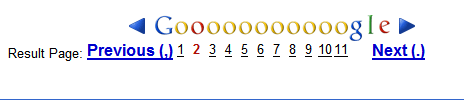
To move to the Previous or Next page of the search results, on Google at least, you can use the comma (,) or period (.) respectively - see them added in brackets? Just type the comma etc without any brackets:

(Note, if the previous/next keys stop working you may need to uninstall and reinstall that extension, I've had that issue myself anyway.)

This extension works on other search sites too. But you can't yet move to the previous/next page of the search results with other search engines like Yahoo, although that's on the developer's todo list for the future (see under "Possible features"). Well done and thanks to Jesse Ruderman for a very useful extension.

(By the way, while on keyboard shortcuts, I've updated my paean to hotkeys to link to a blog dedicated to keyboard shortcuts, Mousethreat, no not solely because he linked to my post but because I love hotkeys and like the idea of a blog dedicated to them. Yep call me a geek, though I'd prefer "power user"...)

Personal data: one law for government, another for citizens?


It now seems that "personal data" means one (narrow) thing when you're trying to get information which a government agency has about you, but quite another (broader) thing if you're being prosecuted for breaching data protetion laws. Surprise surprise...

Yes, this is oldish news (which I first read on Out-law), but I want to do my bit to publicise the discrepancy.

The Out-law article summarises the position, but basically when Michael Durant tried to use the Data Protection Act to get info held by the UK Financial Services Authority about him, the court said he had no right to it because merely mentioning a person in a document does not amount to “personal data” under the Data Protection Act, so they didn't have to give him the information (see this other article).

Yet when Jacqueline Rooney was prosecuted under the Data Protection Act for giving her sister information she had found using police computers about a police officer (who'd had a relationship with her sister), the court said that she had unlawfully disclosed personal data and she was convicted. She'd only told her sister that he'd moved, but not where he had moved to (according to this more detailed article).

Now I don't condone what she did and I think the result of that prosecution was the right one - people just shouldn't be able to use personal information held in government databases for their own private purposes. But I do think that Mr Durant should have been given access to the info about him held by the FSA - the court there should have had a wider view of personal data, as wide as the one in the Rooney prosecution, in fact. But, the court said what it did and the House of Lords refused to hear his appeal, so that's that (unless he's still appealing to Europe?).

The Out-law article points out:
"When it was someone looking for information from the FSA it was a narrow definition: the court said 'no, that is not personal information'," said Cullen. "But when it is a criminal case involving misuse of personal data the court used a very wide definition of personal data, which is interesting."

So, it seems there's one law for government and other organisations from whom we seek information about ourselves, and quite another for us mere citizens!

Free BBC audio and video clips no more after 26 September 2006


The BBC's Creative Archive trial, offering free downloads and personal re-mixing of audio and video clips or full programmes from the BBC's archive
under their special Creative Archive copyright licence, is going to end on 26 September 2006, according to a news release of 18 September on the Creative Archive info site.

The BBC's Governors are going to consider if the Creative Archive meets a "public value" test. Let's hope they conclude it provides enough public value!

So download the clips you want from the archive while you still can (including historic clips from the early days of television). (Sorry only UK residents can access the archive, that's the BBC rule.)

The good news at least is that other participants in the Creative Archive initiative will still be releasing their content, e.g. ITN Source is going to be sharing some of its content under this licence.