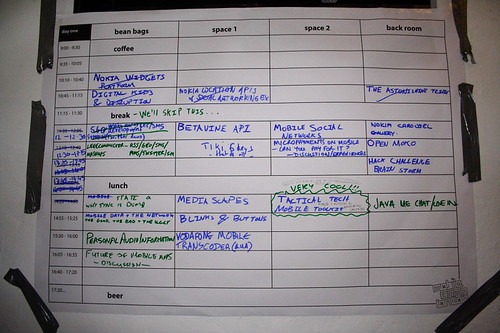
(photo by Futurescape)
Where could you find a Brad Pitt-lookalike and a 6'6" tall (here's why he's lucky) Latino guy who's into kinky women? Why, at mobileCampLondon 2007 last weekend, of course. Who says BarCamp isn't for girl geeks?
You'll have to view the presentation videos or photos to figure out who I might possibly have meant. I'll even offer a prize to the non-attendee who works it out by 23.59 on Sunday 21 October 2007 - attendees are disqualified, I'll pick duplicate winners out of a hat. Entries on a postcard (or SMS text!) please, or preferably via a comment on this blog entry...
But lest you think girl geeks are only interested in just one thing - the weekend wasn't just about hacking mobile apps, nope. The wide range of presentations included the open mobile comms platform OpenMoko, mobile text to speech via Otodio, social mobile networks, and even wearable technology where you can hug yourself to give a friend a hug (if you're both wearing "hug shirts" and carrying Bluetooth phones), and I got a few ideas about what Psion 5mx replacement with usable keyboard I might get, or should avoid.
Overview of Barcamp
So, what was BarCamp like? Barcamp involves the concept of "user-generated conferences" run according to certain loose "rules". It was my first BarCamp ever, fun and fascinating but exhausting. I volunteered to wield my newish camcorder, bought especially for geek events - partly because I thought I'd be less likely to be caught in front of a camera if I was behind it, as I blog anonymously, and partly because I was a scaredycat about presenting (see rule 8 of the rules of BarCamp), plus again I thought presenters were more likely to get photographed or videoed.As it turned out, no one went round saying "Aha! Newbie!" and forcing us to present at mousepoint (or even Powerpoint), so I needn't have worried on that score. Shame no one told me that people don't in fact stalk around BarCamp tying newbies to a chair in the middle of circling laptops and prodding them with laser pointers to make 'em talk.
The venue was a huge concrete-floored room provided by Fjord, in one of those tucked-away streets you'd never know existed till you had to find your way there, just off Carnaby Street in the heart of London. The room was huge in the floorspace rather than high-ceilinged sense, with a fun 3-walled bean bags area, but otherwise just partitions between different presenting and hacking spaces. Someone had come over all the way from Amsterdam to set up free wi-fi for the weekend.
The mobileCamp London event, organised by Victor Szilagyi, was sponsored by: and hosted by Fjord.
The idea with BarCamp is that, having signed up in advance on the Barcamp wiki, you turn up and sign in (and get your freebies from the sponsors!). There's a whiteboard with timeslots, and whoever wants to present just writes their topic and name against a slot (see pic above).
But hardly anyone had turned up at the scheduled registration time of 9 am except the poor volunteers who'd offered to help with registrations (hats off to Feren Calderwood and Nick Middleton!). The day was meant too kick off at 9.30 and I squeaked in at about 9.40 am, but in fact the first session didn't start till 10.30 am, no surprise there - sensibly no presenter had put their name down for any earlier slots. On day 2 I arrived at 10.30. I figured with free beer the previous evening I'd be one of the earlier ones. Amazingly, some had arrived for 10.
At the risk of making Tantek Çelik tsk tsk or even tut-tut, I have to report that, as you can guess, they didn't stick strictly to the rules of BarCamp - topics and names weren't written in presentation slots (a rule I really wish people had stuck to, and more), intro lengths were totally variable and definitely more than 3 words long, and presentation lengths didn't stop when they ran into another slot - the other slots just got moved to start later.
Cafetière coffee and small bottles of water were available all day, and even scones, thanks to the host and volunteers. But though coffee is a major food group for geeks, it did make for some hyperness especially as the room got quite cold, so if you wanted a hot drink you had to have a coffee. One of the presentations incidentally included a slide showing pics of webs woven by spiders who'd been fed marijuana, LSD, caffeine etc. Guess which webs were the worst? That's right - spiders on caffeine wove the most incoherent webs, they couldn't even manage more than a few random threads. Luckily, on the second day there was hot water and teabags, but I think my brain has only just about recovered from all that caffeine!
As a result of concentrating on videoing, I didn't get to chat with as many people as I'd have liked to, or (sob, wail, tearing of hair) play with as many prototypes - there was a 8GB Nokia N95 there, I heard. But still I managed to swap cards with some people, and even got a few LinkedIn invites after the event, which has prompted me to make a note to send out a few myself too.
What about the girls?
I was chatting with Sarah Blow (founder of the London Girl Geek Dinners and related blog), and we were both surprised and pleased that there were more geek girls there than we'd expected. But when "Ooooh, sooooooo many women!" means fewer than 10 out of the nearly 100 who signed up, that's still very telling about the IT industry. And at least 4 or 5 of the women there were from Fjord, the host, or from sponsors or speakers like Orange Partner and Cute Circuit. Hmmm, maybe girl geek attendance wasn't that good after all.At the 2nd anniversary Geek Girl dinner (see also Maz's Girlygeekdom post and videos), one issue discussed was how at tech conventions often men wouldn't talk to the women until they had proved their technology credentials. Ironically, this story from last weekend proves the point (names withheld to protect the guilty and innocent!). A geek girl was talking to a guy at MobileCamp about precisely this subject, i.e. the way that the guys at that event were totally ignoring the girls, when 2 guys sat down opposite her, right next to the man she was chatting with. She said "Hi" to them, but they totally blanked her. She had to prove herself to be worthy of their time before they would even say a word to her: they listened in to about 20 minutes of her conversation with the guy she was talking to, before saying anything to either of them.
It is very disappointing that in this day and age that kind of attitude towards women still exists in such abundance in the technology industry. May I point out the following women who made great advances in technology that fundamentally affected computing/communications - and I'm just naming one per century, there are more:
- 19th century - Ada Lovelace (daughter of Lord Byron) - who documented Charles Babbage's analytical engine, widely thought of as the first computer, and added notes which Babbage himself acknowledged corrected his mistake, with a specification recognised by historians as being the first computer program
- 20th century - Hedy Lamarr - who co-invented a system of frequency hopping on which modern spread spectrum broadcast communications technologies are based, including wifi wireless networking and CDMA mobile telephony, and who was honoured by the EFF
- 21st century - Wang Xiaoyun (home page) - who, with her team (including Yiqun Lisa Yin, another female scientist) cracked the two hash functions most widely used: at the end of 2004 SHA-1, an algorithm invent by the US National Security Agency and described by New Scientist as "the gold standard security algorithm that underpins online transactions" - it's used in digital signatures and other internet encryption protocols such as SSL, SSH and also PGP - and before that, she broke MD5. While it will still take a lot of computing power and a lot of time for this attack to succeed in practice, the fact is that she cracked it, and the search for a more secure successor is on.
Anyway, back to mobileCamp, I will say that the girl geek in that story wasn't me. But then if I really want to talk to someone I usually just go up and corner them where they can't get away, as I'm used to most people not coming up to talk to me - and that includes women, so I think it's more than just my gender which puts them off approaching me. Maybe it's the 666 tattooed on my forehead. Go figure.
Moving on, here's a different story, which might show how males and females approach tech quite differently - or might not! Being a keyboard fan, my fave gadget is my Psion 5mx for productivity and play on the move, and I'm still looking for my dream gadget to replace it, oh arrrr, nothing can beat the good ol' gadgets we had in my time, arrrr. I bugged the Nokia boys and others about why phone handset manufacturers don't build a phone with an "in between" form factor - bigger than the teeny-keyed Blackberry or Nokia N95 (or even E90 - just a tad bigger than an E90, please!), but smaller and lighter than a UMPC - i.e. exactly like the Psion 5mx, especially the patented sliding keyboard which you can touch type on, combined with mobile phone and updated with colour screen, wi fi, etc.
The guys all thought there was no market for it, perhaps being in beefy bloke "Yeah me macho me can lug heavy laptop round a-l-l day, real men laugh at lower back trouble, hahahahaha! owww" mode. However the women, who presumably have smaller fingers which can touch type on a Psion-sized keyboard, and who generally are less keen on bulky heavy laptops, all liked the idea. So there's a gap in the market there to flog small laptops-cum-mobiles to business women (and teenagers, and the like) who care about their backs, which some canny mobile handset manufacturer could exploit - just as there's a gap for credit card companies to exploit for online sales if just one company only bothered to.
Aside on public conveniences (there is a geek and a girl angle, honest!)
The loos were unisex, which was very egalitarian. No open urinals, thankfully for all concerned, I think that would have been taking the concept of "open" too far! - but one set of toilet cubicles for all, each with doors (again, thankfully).I have to say that while I'm all for equal rights and equal treatment, personally I'm not in favour of unisex loos, for practical reasons of hygiene shall we discreetly say (tactful translation: many men make more mess), rather than because guys are always forgetting to put the toilet seat down, never mind game theory or modelling or statistical analyses!
While I'm on this digression: yes, I prefer segregated WCs or at least segregated designated cubicles, but there are never enough loos for women, in the sense of absolute numbers of them. For true equality in terms of usage time and throughput of the same numbers of people, there should in fact be more cubicles for women than men, and it's even an architectural / building design point that there should be twice as many toilets for women than men - but that rarely seems to be the case, in the UK at least. But then we're probably architecturally behind anyway, pun intended.
Now, finally, to the geek point. The Fjord loos marked my first encounter ever with the Dyson Airblade hand dryer, and believe it or not people were talking about them (of course you'd believe it, this is a gaggle of geeks we're talking about here!). Here's proof, and it's probably telling about me that the only photo I took at the whole event was of this gizmo:

As you can tell, the gadget freak in me really liked the Airblade. (I hate Dyson's customer service though. They let their generally well-designed hi tech products down by having a crappy customer service department - see, there's still a vague toilet connection here. After the only time I've been forced to deal with Dyson's customer disservice team, I've refused to buy any Dyson products ever again. I'll use 'em elsewhere, e.g. the Airblade at Fjord, but I won't let Dyson have any more of my own hard-earned money. As regular readers will know, I have a big bugbear about bad customer service. I've boycotted other companies before but relented when they apologised and made up for it - Dyson were so awful, even worse than BT and that's saying something, that I don't feel like ever giving them another chance. /digression.)
The videos
Right, back on topic. I managed to video quite a few of the presentations, and for one I missed I nabbed the presenter for a video interview/demo.For reasons of download speed and targeting I've published a separate post per video, except for the introduction. Where I've had thoughts to add on a particular presentation, I've done so in the post for the video. Here's the list:
- Welcome and intro to mobileCamp London 2007 (8:20):
- Nokia Series 60 - how to develop web widgets for Nokia s60 cellphones - very handy for developers
- Nokia Series 60 geo-location technologies - again mainly for hackers, a bit less so than the previous session
- Mobile social networks - how should or might they progress?
- OpenMoko video interview / presentation and demo of Neo1973 handset - very interesting presentation and demos of the world's first open source handset, based on Linux
- State, and why sync is dumb - mobiles and other portable electronic devices should remember "state", e.g. the point in the song you were playing, but don't...
- Mobile data & the networks: the good, the bad & the ugly - essential viewing for mobile developers, in my view, on how the UK mobile networks handle mobile data, charging etc
- Personal audio information - Otodio's text to speech technology for mobile
- Wearable technologies and CuteCircuit products, imminent & not so imminent, including the "hug shirt" that you pair with your Bluetooth mobile!
- Mobile hack challenge presentations, demos and results - congrats to the winners, some fab ideas there.

- One Laptop Per Child (OLPC) XO-1 demo - someone from OpenedHand had brought one along. Cute, most people wanted to run away with it including the guys!
Imp's Laws of BarCamp
Finally, here's Improbulus's 8 laws of mobileCamp - partly a tongue in cheek variation on the 8 rules of BarCamp, maybe, but I do mean these seriously for organisers and presenters!:- Start time - be kind to geeks. Never, ever expect geeks to turn up to anything for earlier than 10 or 11 am! Especially at the weekend.
- Name tags or badges. Yeah name badges are a bit corporate, but given that BarCamp often has corporate sponsors that's not a reason not to have them. They really help, to track down people you want to stalk talk to (or avoid). However, as a minority request, I'd like one that also says "No photos" so that people know who there doesn't want to be photographed or videoed - I know BarCamp is meant to be open, but I have my limits!
- Clear info about your presentation on the whiteboard (Imp's mod to rule 3 of the Rules of BarCamp, BY-NC-SA of course) - please don't just put down the name of your company, product or service and expect everyone to instantly recognise it or have the time to search for info about it before your presentation starts (you notice I dutifully avoided the G-word as a verb, I think it's a losing battle for Google, m'self). Please also add a clearly-written summary on the whiteboard of what that product or service is about. That's why I didn't go to some presentations I'd otherwise have been interested in, because I had no clue from the name what it was about - e.g. "Blinks and Buttons" meant nothing to me, and the title of the 6-key keyboard session (which I'd have wanted to see) looked like "Tiki 6 days" and I swear the "6 days" wasn't even there when I first looked at the board! Whereas I went to Mobile data & the networks because there was a clear description on the whiteboard of what it was about.
- To presenters - be kind to the audience. Even if you're using slides and you're talking about a particular slide, please remember to direct your mouth towards the audience, not at the screen. They'd quite like to see both the screen and your face, not the back of your head. Having mics is good, thank you host/sponsors, but dear speakers, please use the microphone properly - it's received mike geekery wisdom that, although most people don't realise this, you have to hold it very close to your mouth for it to pick up your voice: half an inch can make all the difference (as the actress said to the bishop). And please give your name & affiliation clearly at the start, and, if you wish, contact details at the end. And during the discussion phase, please repeat the question clearly into the mic for the benefit of those of us who weren't sitting near enough mumbled questions to hear them.
- Facilities. Of course, free wi fi is de rigeur. And not only lots of projectors for presenters' slides, and mikes for presenters with speakers, but also tons of power points and extension leads for people to plug their laptops into, please. There were quite a few, but still not enough mains adaptors for everyone. It was interesting that Sarah and I had both thought to bring extra adaptors (that's girl geeks for you - foresight, logic and preparation!), and others (mostly guys, ahem) predictably duly inserted their plugs into our spare sockets. Another wishlist item - roving mics for questions, sometimes you couldn't hear the discussion properly. And heating for cold rooms...
- Nutrients. Not just lots of water and coffee on tap, but also tea please (preferably Earl Grey, but of course). And soft drinks too. Even for the free beer at the end of the day, don't forget there may be some people who can't take alcohol for health, driving or religious reasons, a major bugbear of mine e.g. at the Minibars. Last weekend scored high on this front, especially on the 2nd day when there was tea.
- Freebies. Not essential, but nice, thanks you sponsors! However, should you decide to hand out free gifts, please don't forget that if you're providing T-shirts or sweatshirts there may be female geeks there too. Last weekend there were (miracle of miracles!) a few T-shirts in size "S", but supplies of those ran out far too soon. I've moaned about this (with photos!) before.
- To participants. It seems a good idea always to bring business cards or cards with personal contact details, for networking. I generally remember people better if they've given me one, maybe the card helps act as a mnemonic. Interestingly for a geek event, the only person who offered to Bluetooth me a business card was Feren Calderwood - female! Maybe other geeks (ahem) think it's too time-consuming to whip up a Bluetooth e-card..? Finally, do make the effort to talk to at least one girl geek, if only to see whether you might be able to get your widgets into her honeypot. Wail, no one's tried to get into my honeypot for months now, I think I may as well give up...
For lots more, see the official mobileCampLondon blog, and photos tagged mobileCampLondon on Flickr.
And remember, if you want to enter my compo (very cheap prize promised as I'm very cheap!), the deadline is 23.59 London time on 21 October 2007.
Tags:


